
How AI is Impacting UK Travel Planning
How UK travellers now use AI to plan trips, choose excursions and decide what to do - and what it means for tourism and hospitality operators who want to appear in ChatGPT, Claude and Gemini recommendations.
The short version
52% of UK travellers now use AI tools[1] to help plan their travel, and among those who use AI, most reach for it to choose local attractions, restaurants and things to do. For operators that means the shortlist is increasingly built inside an AI answer, before your website is ever opened. Excellent reviews do not put you in that answer. Earned visibility does.
Your best future customer just asked an AI where to go. Are you the answer?
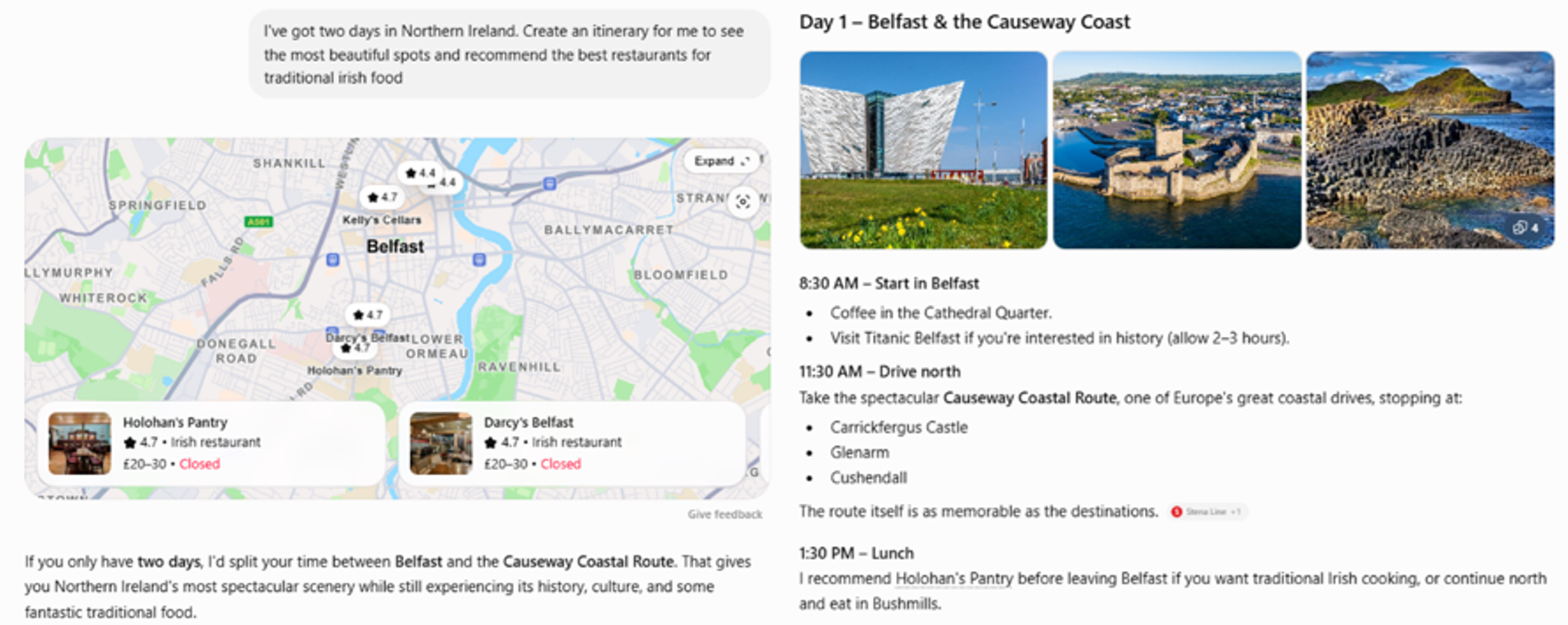
I planned two days away last week without opening a guidebook, without a single Google search, and without asking a soul who had been. I asked an AI assistant what to do, where to eat, and which of two coastal walks was worth the drive. It gave me exactly what I was looking for. It named businesses. And here is the part that should give every operator pause: I booked what it told me to.
I am a reputation person by trade, so I notice these things. The assistant did not hand me 10 blue links and leave me to make up my own mind. It made the shortlist for me. A few businesses were in the answer. Most were not. The ones that were not never got a look in, however good they are.
That is not a search result. That is a verdict.
And it is a verdict on serious money. Tourism Economics, the Oxford Economics team that counts this for VisitBritain, put the sector's contribution to the UK economy at £147 billion in 2024, 5% of everything the country produces, and expect it to reach £161 billion by 2030. The moment a visitor decides where to go and what to do is the front door to all of it. That door is being rebuilt around the AI answer, and most operators are nowhere near it.
How many travellers actually use AI to plan trips?
More than most operators think, and the number is climbing fast. 52% of UK travellers now use AI tools to help plan their travel, up from 40% a year ago, the fastest growth of any major market in Europe, and ChatGPT is the tool of choice for 35% of them. For most people the first job they hand the machine is inspiration and ideas, cited by 47% as their main use.[1] Inspiration is the top of the funnel. It is where the decision about your business is made, or lost, before you get a chance to compete for it.
Depending on how you ask the question, the figure moves a great deal. ABTA, measuring the narrower matter of using AI purely for holiday inspiration, puts it at 8%, though even that has doubled in a year and reaches 18% among 25 - 34 year olds. So, which is it, 52% or 8%? Both. They are measuring different things, any planning help vs inspiration alone. The honest reading is that the range runs from meaningful to enormous, and every survey points the same way, upward.
And no, it is not universal yet. Around half of British travellers still say they are uncomfortable letting an AI organise their trip, YouGov's 2025 survey found. Good. That is exactly why this is the moment to act and not the moment to wait. Reputation is built in the years before everyone else notices it matters. By the time your competitors are comfortable, so is everybody's customer, and the visible businesses will already be the ones the machine trusts.
Look at the direction as much as the level. The movement from 2024 into 2025 was steep, some of these figures doubling in a single year. The 2026 waves are still to report in full, and I will be watching them with real interest, because nothing here suggests the curve is about to flatten.
And here is the anecdote the surveys have not caught up with. In my own circle the figure is not 52%, it is 100%. Every person I know has used AI in some way for a trip, to shortlist a hotel, settle an argument about where to eat, or build a rough itinerary in 90 seconds. Not one of them would call themselves an early adopter. They would call themselves normal. That’s what a behaviour looks like just before the statistics admit it has become the default.
What are travellers using AI for, booking or choosing what to do?
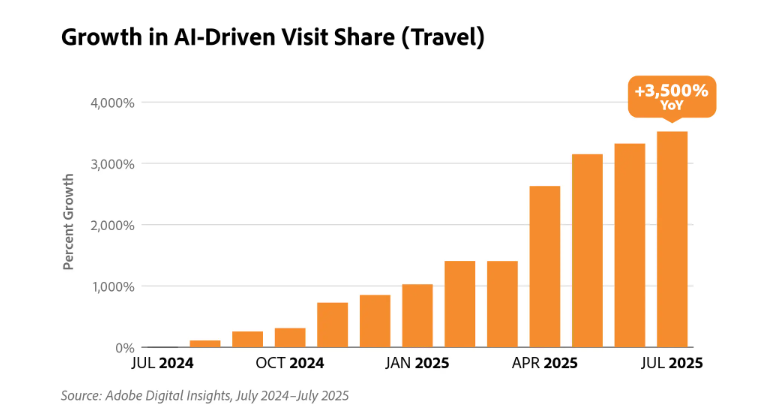
Increasingly, they are using it to choose what to do, which is precisely the decision your business depends on. Here is the statistic I would pin above the desk of anyone running an attraction, a tour, a restaurant or a day out. In the US, where the habit is further along, Adobe found that 29% of consumers have used AI to plan a trip, and of those, 53% use it to find local attractions, restaurants, hidden gems and the best times to visit. Not flights, not hotels. What to actually do when they arrive. That is your booking. It is the 'what shall we do today' question, and it is now being answered by a machine before your website is ever opened. Traffic to US travel sites from generative AI grew by 3,500% in a single year.
These are not idle browsers, either. Of travellers who have used generative AI to plan, 84% say it improved the experience, and visitors who arrive at a travel site from an AI assistant bounce 45% less often than the average, according to McKinsey. They turn up warmer, clearer and closer to booking. The industry has certainly noticed: 90% of major travel companies have now launched a generative AI project of some kind.[2] The point of discovery is being rebuilt, and it is being rebuilt around the answer, not the link.
Why isn't my business showing up in AI travel recommendations?
Because the AI does not build its answer from your website, and this is the part nobody selling you a website refresh wants to say out loud. Your 500 glowing reviews do not put you in that answer – although they definitely help! Neither does your booking engine, your loyalty scheme or the lovely photography on your home page. The assistant does not read your site and decide you are wonderful. It assembles a recommendation from what the rest of the web says about you, and AirOps found that 85% of the brand mentions that surface in AI search come from third-party pages, not from a business's own domain. Your visibility in the answer is earned somewhere other than your own website. It is a reputation problem wearing a technology costume.
How to get cited by AI
This is my whole argument in one line. You do not appear in AI recommendations by optimising your own pages harder. You appear by being genuinely well documented across the places these tools trust, in editorial coverage, in the communities where your visitors already talk, in accurate and consistent information wherever your business shows up. That is earned visibility, and it is slow, built evidence by evidence, exactly as reputation has always been. There is no clever technical shortcut, whatever this week's acronym is being sold as.
If you want to know where you actually stand, start with the uncomfortable version of the truth. I offer a free AI Visibility Heatmap across the three assistants your customers are most likely to reach for, ChatGPT, Claude and Gemini, and show you exactly what they say when someone asks for the best of what you offer in your area. Not what you hope they say. What they say. Most operators find it sobering. All of them find it useful.
Reputation. Visibility. Pipeline. In that order, and never the other way round.
[1] MMGY Travel Intelligence, 2026 Portrait of European Travellers (2026) reported via Hospitality Net: https://www.hospitalitynet.org/news/4132965/uk-travelers-lead-europe-in-using-ai-and-social-media-to-plan-holidays-new-study-reveals
[2] Skift Research and McKinsey, State of Travel (2025) reported via Forbes, 12 November 2025: https://www.forbes.com/sites/jefffromm/2025/11/12/how-ai-will-reimagine-travel-in-2026-from-dreaming-to-doing/
Frequently asked questions
How do travellers use AI to plan trips and excursions?
More than half of UK travellers (52%) now use AI tools such as ChatGPT to help plan their travel, most often for inspiration and ideas. Among US travellers who use AI, 53% use it to find local attractions, restaurants and things to do, so the tools increasingly answer the 'what shall we do' question, not just flights and hotels.
Why isn't my hotel or attraction showing up in AI search results?
Because AI assistants do not build recommendations from your own website. They assemble an answer from what the wider web says about you, and 85% of the brand mentions that surface in AI search come from third-party pages rather than a business's own domain. If you are absent from those trusted sources, you are absent from the answer, however good your own site is.
Do great TripAdvisor or Google reviews mean I will appear in AI recommendations?
No. Strong reviews help your reputation, but AI assistants draw on a much wider set of sources, including editorial coverage, directories and community discussion. A business with excellent reviews can still be invisible in the AI answer if it is thinly documented everywhere else. Reviews are necessary, but on their own they are not enough.
How do I get my business recommended by ChatGPT and other AI assistants?
By earning visibility in the sources these tools trust, rather than by optimising your own pages harder. That means editorial coverage, presence in the places your visitors already talk, and accurate, consistent information wherever your business appears online. It is slow, reputation-led work, and there is no reliable technical shortcut.
How can I check whether my business appears in AI travel recommendations?
Run a free AI Visibility Heatmap across the three assistants your customers use most, ChatGPT, Claude and Gemini. It shows exactly what they say when someone asks for the best of what you offer in your area, so you can see whether you are in the answer or missing from it entirely.