
AI platforms now decide which architecture practices get recommended to prospective clients. We tested nineteen against the six leading platforms. Here is what the best architecture marketing looks like when the first audience is a machine.
Architecture AI Visibility: the new test of the best architecture marketing
When a prospective client wants an architect, more of them now open ChatGPT, Gemini or Google's AI Mode before they open a search results page. The platform gives them a short list of names, and the practices that are not on that list are not in the running. This is architecture AI visibility, and it has quietly become the sharpest measure of whether a practice's marketing is actually working.
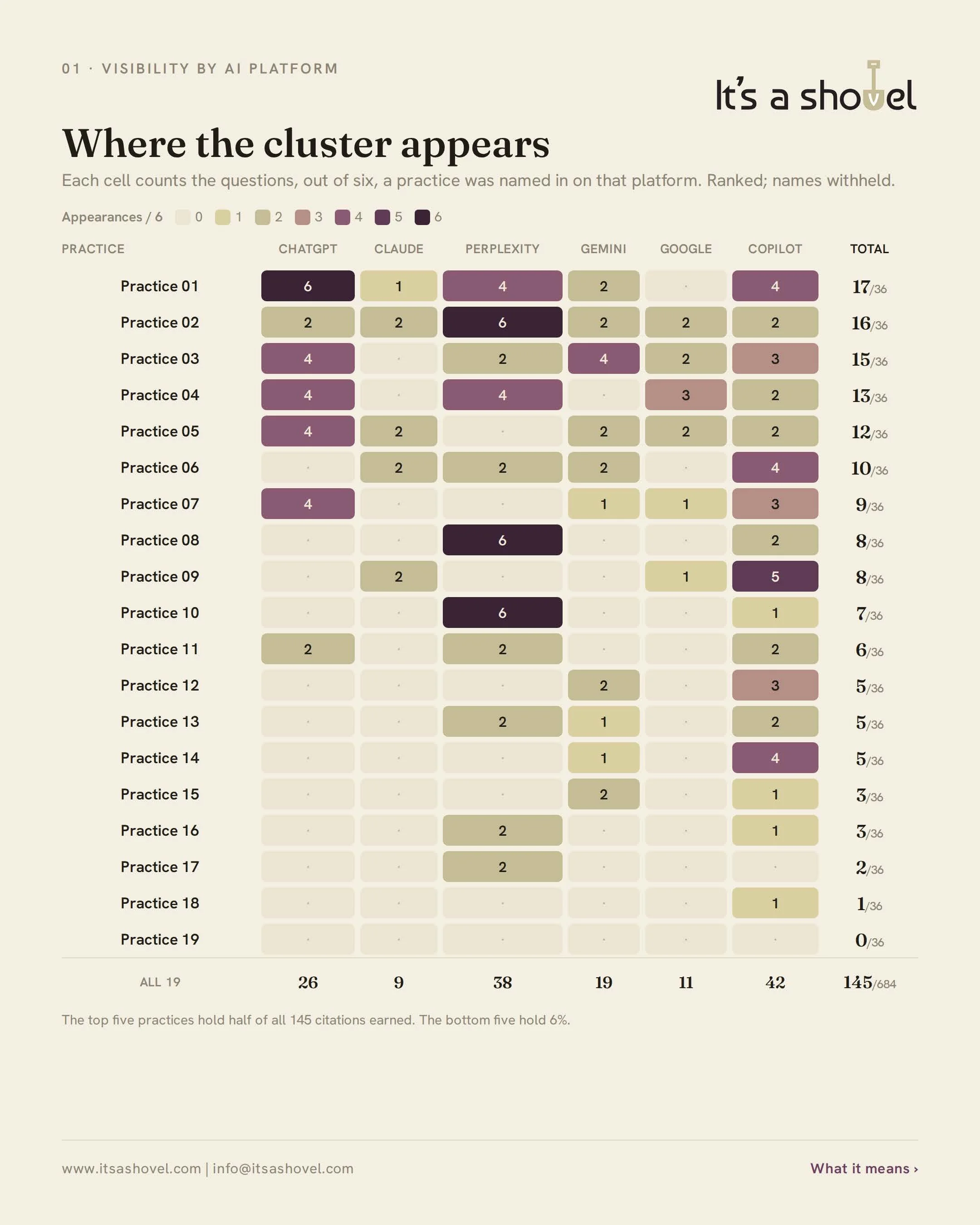
We ran a sector scan to see how settled the picture already is. The short answer is that it is very settled, and for most practices it is not flattering. Five practices out of 19 accounted for half of every recommendation the platforms gave. The bottom five accounted for 6% between them.
Key takeaways
Architecture AI visibility is whether AI platforms name your practice when a client asks who to use. It is fast becoming the front door to new work.
In our South West sector scan, five of nineteen practices took 50% of all AI recommendations. The bottom five took 6%.
The order does not track size, age or reputation. It tracks how citable a practice is.
No practice has locked its position. The leaders appear in fewer than half of answers, so the field is still open.
The best architecture marketing now treats AI platforms as a primary audience, not an afterthought.
What is architecture AI visibility?
Architecture AI visibility is the degree to which AI platforms, such as ChatGPT, Claude, Perplexity, Gemini, Google AI Mode and Copilot, name and recommend a practice when someone asks a relevant question. It is the AI-era equivalent of ranking on the first page of Google, except the platform usually returns a handful of names rather than ten blue links, so the competition for each slot is far tighter.
It matters because the platforms are becoming the place clients start. Gartner has forecast that traditional search engine volume will fall by around 25% by 2026 as people turn to AI answer engines instead of typing queries and clicking links. Google still sits behind roughly nine in ten UK searches, so it is not disappearing, but the way people use it is changing, and its own AI Mode is one of the strictest gatekeepers of all. A practice that is invisible to these systems is invisible at the exact moment a client is deciding who to consider.
Why AI visibility is now the heart of the best architecture marketing
For years, the best architecture marketing was judged on a portfolio, a tidy website and word of mouth. Those still matter, but they are no longer where the first impression happens. The first impression is now a sentence generated by a model, listing three or four practices, and your name is either in it, or it’s not.
That changes what good looks like. The best-marketed practices are no longer simply the ones with the most polished brochure site. They are the ones an AI can read, understand and quote with confidence. Being citable has become the core marketing asset, and most practices have not noticed the shift.
The encouraging part is that AI visibility and traditional reputation management are not in competition. The same groundwork that earns a citation, clear specialism pages, genuine case studies with outcomes, and real third-party references, also strengthens ordinary search and reassures a human reader. You are not choosing between marketing for people and marketing for machines. You are doing one job well enough that both respond to it.
What we found: a scan of nineteen practices
We tested 19 South West architecture practices against the six platforms above, asking each one the same questions a prospective client would ask across three common specialisms, residential extensions, listed building and heritage work, and sustainable design. That gives thirty-six possible mentions per practice. We counted how many each one earned. Practice names are withheld here.
South West Architecture Practices AI Visibility Heatmap
Three findings stood out.
The winners are already chosen. Five practices took half of every recommendation across the six platforms. For everyone else, the competitive question has changed. It is no longer whether you can win the top slot, it is whether you appear at all.
The winners are not who you would expect. The order did not track size, age or local renown. Several long-established and well-regarded practices barely registered, while the practices the platforms favoured were often smaller and more sharply specialised. Visibility here is earned by being citable, not by headcount or heritage, which means the order can still be changed.
No one has locked it down. The leading practice appeared in fewer than half of its possible answers, and Google AI Mode, the strictest platform of the six, named only five of the 19 practices at all. No practice owns this space yet. The top positions are visible but undefended, which is precisely why now is the moment to compete for them.
An honest word on method
This is a snapshot, not a verdict for life. AI answers shift as models retrain and as practices publish new work, so a scan run next quarter would not be identical. We counted a practice as present wherever a platform named it, including under a former trading name, and the questions matter, since a different set of prompts would move some cells. What did not move is the shape of the result. The concentration at the top and the emptiness at the bottom were consistent across every platform we tested.
How the best-marketed architecture practices earn AI citations
If AI visibility is the new test, here is what the practices that pass it tend to have in common and none of it is exotic. It’s disciplined marketing aimed at a new reader.
A clear specialism page for each core service. One substantial, well-structured page per specialism, written to answer the question a client would ask, is the single strongest asset we see. Vague "what we do" pages do not get cited.
Case studies written as outcomes, not galleries. AI can quote a project that explains the brief, the constraint and the result. It struggles with a row of captionless images.
Offline reputation that the web can see. Awards, speaking slots, press coverage, membership of respected bodies and strong client relationships are where most third-party references start. Offline reputation building is not a separate activity from AI visibility, it is usually the source of it, once that reputation leaves a trace online.
Genuine third-party references. Mentions in trade press, awards bodies, directories and partner sites are what tell a platform your practice is real and respected. This is reputation the machine can verify.
Clean, structured information. Consistent naming, clear contact and location details and tidy on-page structure make a practice easy to read and hard to confuse with another.
A consistent entity. One name, used the same way everywhere. Practices trading under two or three name variants dilute every signal they send.
Do these well and you tend to rise on classic search at the same time, because the qualities that persuade a model are the qualities that persuade a person.
Where does your practice sit?
Any practice can find out exactly where it sits in this order, on which platforms it appears, and what it would take to climb. That is what we do. You can see the service here.
Written by Jessica at It's a Shovel. It's a Shovel is a strategic communications and reputation management consultancy helping professional services firms to enhance their online and offline visibility in order to build their pipeline. Figures are drawn from the South West Architecture and Planning sector scan, run on 30 June 2026 across ChatGPT, Claude, Perplexity, Gemini, Google AI Mode and Copilot. Practice names are withheld in this public version.
Frequently asked questions
What is architecture AI visibility?
It is whether AI platforms name and recommend your practice when a prospective client asks a relevant question. It is becoming the AI-era equivalent of ranking on the first page of search, with far fewer slots available.
Why does AI visibility matter for architecture marketing?
Because more clients now begin their search inside an AI platform. If your practice is not named in that first answer, you are not considered, however strong your portfolio. It has become a core part of the best architecture marketing, not a niche add-on.
How do I improve my practice's AI visibility?
Publish clear specialism pages, write case studies as outcomes rather than image galleries, and keep your on-page information clean, structured and under one consistent practice name. Then build the offline reputation that feeds it, through awards, press, speaking and industry membership, since those are what create the genuine third-party references AI reads and trusts. An audit shows which of these gaps is keeping you out of the answer, and which is quickest to close.
Is AI visibility different from SEO?
It overlaps but is not the same. Traditional SEO aims to rank a page in a list of links. AI visibility aims to be the practice a model names in a short, synthesised answer. The good news is that the work behind one largely supports the other.
What is generative engine optimisation (GEO), and how does it relate to AI visibility?
GEO is the practice of shaping your content and your reputation so that generative AI platforms understand, trust and cite your practice. If architecture AI visibility is the result, being named by AI, then GEO is the work that earns it. It sits alongside SEO rather than replacing it, draws on the same online and offline foundations, and is fast becoming a core part of the best architecture marketing.
Does this replace word of mouth and reputation?
No. It reflects them. Practices with genuine reputation and citable work are exactly the ones AI tends to recommend. AI visibility simply makes that reputation legible to the systems clients now use first.