
GEO can lift your AI visibility by up to 40%. But here’s what that number leaves out.
Generative engine optimisation, or GEO, does improve how often AI assistants cite you, by up to 40% in the founding academic study. But that figure comes with caveats, and the lift it describes has a ceiling. The techniques that work are ways of making genuine authority legible to a model, not ways of creating it, which is why reputation, rather than technical optimisation, is what ultimately decides whether an AI recommends you.
That is the short version. Here is why it holds.
Is GEO real, or just the next acronym?
It is real, and the market has priced it in. The up-to-40% figure comes from the founding academic paper on the subject, presented at a peer-reviewed conference in 2024. And in November 2025, Adobe agreed to buy Semrush for around $1.9 billion, a deal it framed around brand visibility in the agentic AI era.[1] So GEO works, and it is now a category with real money behind it. The problem is what gets left out when that 40% is quoted back to you, because the same research that produces the number also explains why the technical layer runs out of road.
What did the GEO research actually measure?
The 40% is an upper bound, not a typical result, and it comes from a specific set of moves. When researchers tested nine different ways of rewriting a page, three did the heavy lifting: adding relevant statistics, adding quotations from credible sources, and citing sources properly. Notice what those three have in common. They are all ways of making a page more evidently grounded in something outside itself.
Two of the paper's findings are quoted far less often, and they are the interesting ones. The first is that keyword stuffing, the oldest trick in the search optimisation book, produced little or no improvement in AI answers. The old technical playbook simply doesn’t carry across. The second is sharper still. The researchers tried rewriting pages to sound more authoritative, more persuasive in tone, and it produced no significant uplift at all. You cannot talk your way into authority. The model is not fooled by a confident voice.
There is an important caveat, and the paper is candid about it. Those results come from a controlled benchmark, a purpose-built set of test queries rather than the open web, with a single real-world check on one engine, Perplexity. The authors themselves note that how well the methods work varies from one subject area to the next. And the study was run in 2024. The engines people actually use now, ChatGPT search, Google's AI Overviews, Gemini, Claude and Perplexity, have moved on a great deal since. So, the 40%, and the specific methods behind it, are best read as evidence of what worked in that experiment, not as fixed rules that hold on every engine today.
Read all of that together and the shape becomes clear. Structural work helps a model find, understand and quote you. It makes genuine authority legible. What it cannot do is manufacture authority where none exists.
Does domain authority help you get cited by AI?
No, and the most current evidence points somewhere else entirely. Emerging research from 2025, which tested how today's live AI search engines actually choose their sources, found that they lean systematically and overwhelmingly on earned media, third-party authoritative sources, over the content a brand publishes about itself or posts on social platforms. Google, by comparison, draws on a more balanced mix. The same work found that the engines differ sharply from one another in what they favour, which is a further reason to distrust any single technical playbook. This is emerging work, not yet peer reviewed, but its direction matches everything the commercial data has been saying.
The Role of Backlinks in GEO
And the commercial data says it too. In the retrieval data behind AI citations, pages with the most backlinks were among the least likely to be cited, and domain authority showed no positive correlation with being cited at any level of relevance. The lowest-authority pages performed as well as the highest. Whatever gets a page into an AI answer, it is not the accumulated link equity that traditional agencies spend their budgets building.
The Reddit Effect in GEO
Look at where the citations physically come from. In one analysis of commercial AI search, roughly 85% of brand mentions came from third-party pages rather than the brand's own domain. Most of what an AI says about you is drawn from what other people have written about you. That is not a channel you can optimise your way into from your own website.
The clearest illustration is what you might call the Reddit effect. In that same research, close to half of all AI citations, around 48%, came from user-generated and community platforms, and Reddit alone showed up in roughly 1 in 5 AI answers. It is worth sitting with what that means. When an AI is asked about your category, there is a real chance it is relaying the verdict of a forum thread or a community discussion you have never posted in and cannot edit. You do not own that conversation. You can only earn your way into it, by being the sort of firm people mention unprompted when someone else asks them for a recommendation.
The Value of an AI Referral Click
And when AI does send someone your way, it is rarely to browse. An analysis of nearly two million AI-driven sessions found that AI referrals were a tiny share of traffic overall, around 0.13%, but that they concentrated on the pages closest to a decision, industry pages, tools pages and pricing pages, all several times more likely to receive AI traffic than the site average.[2] The traffic is small and unusually valuable, and it lands where the buying happens. As Cloudflare's chief executive Matthew Prince has put it, earning a referral click from Anthropic is now 30,000 times more difficult to get traffic than it was with the Google of old. The click is becoming and endangered species. Being inside the answer is the point.
Is GEO really different from SEO?
Less than the sales pitch suggests. In its first official guidance on the subject, published in 2026, Google's position was blunt: because its AI features run on the same core systems as ordinary search, optimising for generative AI is, in its words, still SEO, and it explicitly said that special AI-only files and bespoke content rewriting are not needed for its own generative features.[3] The fundamentals it named were the unglamorous ones. Useful content. Crawlable pages. Clear structure. A page experience people can trust.
None of this means the technical layer is worthless. The same retrieval research also found that structured data still earns a measurable citation advantage on some engines, and getting the plumbing right is table stakes. It means something more precise. There is no single trick, no schema tag or file or turn of phrase, that substitutes for being genuinely worth citing. The technical work is necessary. It has never been sufficient.
What actually drives AI visibility?
We have taken to calling this the verdict economy. An AI assistant is not a channel that returns a list of links for you to choose from. It is a judge that issues a verdict, one answer, one recommendation, and it reaches that verdict by weighing what the wider web appears to believe about you. Visibility in that world is not a position you can climb to. It is a probability, and you influence it by being the kind of firm the evidence keeps pointing to.
Can smaller brands compete with big brands on GEO?
The emerging research is candid about the flip side, and it is worth being straight about. These systems carry a bias towards big, established brands, which puts smaller and niche firms at a structural disadvantage from the start. But the way through that disadvantage is not a technical one. It is to become the name that earned media keeps returning to in your particular field. That is reputation work by another name.
Which brings the argument back to where it started. The 40% is a real lift, and you should take it. But it sits on top of something the number cannot see. The statistics that make a page more citable have to be true. The quotations have to be from people who genuinely rate you. The third-party pages that supply 85% of your AI mentions have to exist, which means someone had to have a reason to write them. Every technical lever eventually pulls against the same load-bearing wall, and the wall is reputation.
Reputation. Visibility. Pipeline.
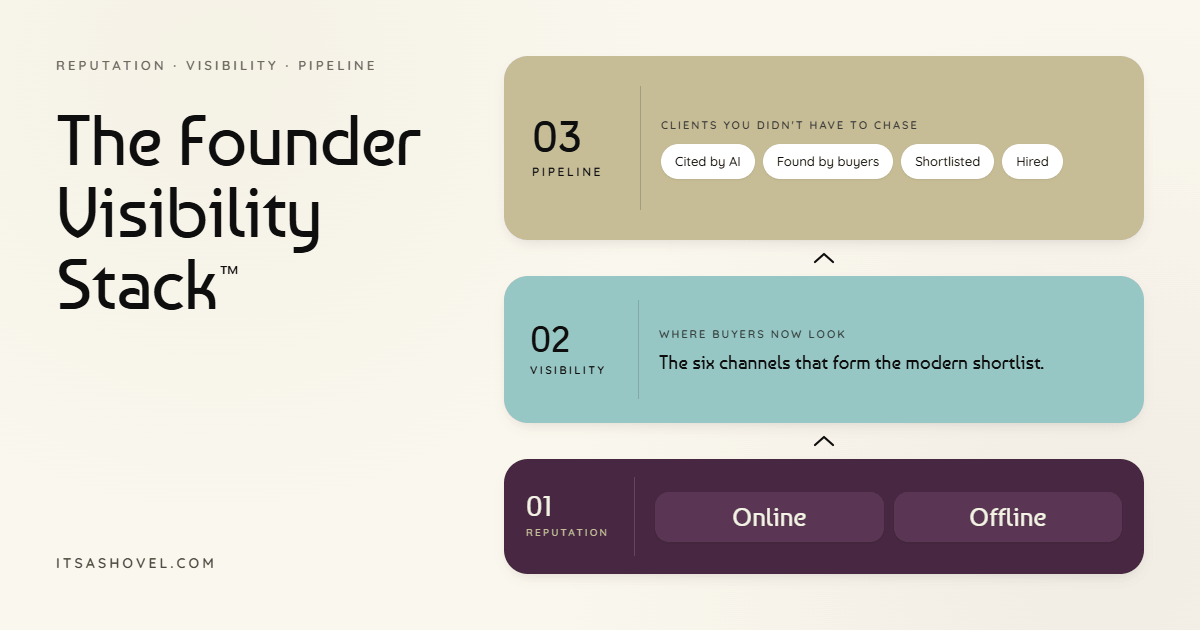
That is the order of operations we build around. Reputation first, earned online and in the real world. Visibility as the outcome of it, across the channels where your buyers actually look, AI assistants among them. Pipeline as the commercial result. It is why the Founder Visibility Stack™ puts reputation at the foundation and treats AI visibility as a consequence, not a product. You do not optimise your way to being trusted. You become citable by becoming genuinely known, and then the technical work has something real to make legible.
Get that right and the sequence takes care of itself. You are cited, found and hired, in that order, because each step depends on the one beneath it.
It's a Shovel builds reputation, visibility and pipeline for founder-led advisory and professional services firms. If you want to see how an AI assistant currently answers when someone asks about your category, our free AI Visibility Heatmap is the place to start, and our Discovery and Strategy engagement turns that picture into a plan. For the thinking behind all of this, readFrom Reputation to Pipeline
[1]Adobe's agreement to acquire Semrush for approximately $1.9 billion, announced 19 November 2025, reported by Search Engine Journal. https://www.searchenginejournal.com/adobe-to-acquire-semrush-in-1-9-billion-cash-deal/561438/
[2]Previsible, '2025 State of AI Discovery Report', December 2025. https://previsible.io/seo-strategy/ai-seo-study-2025/
[3]Google Search guidance on optimising for AI features, 2026, as reported by Search Engine Journal. https://www.searchenginejournal.com/googles-new-ai-search-guide-calls-aeo-and-geo-still-seo/575026/
Frequently asked questions
Is GEO different from SEO?
Only in emphasis. Google's own 2026 guidance states that optimising for its AI features is still SEO, because those features run on its core search systems. The foundations are the same: useful content, crawlable pages, clear structure and a trustworthy page experience. GEO adds content-level techniques that help a model quote you, but it does not replace the fundamentals.
How much can GEO actually improve AI visibility?
By up to 40% in the founding academic study, and only through specific methods: adding relevant statistics, adding credible quotations and citing sources. That figure is an upper bound rather than a typical result. It also comes from a controlled 2024 benchmark with only a single real-world validation, and the study itself found the effect varies by domain, so it is best read as directional rather than a guarantee. The same research found that keyword stuffing and simply writing in a more authoritative tone produced no meaningful improvement.
Does domain authority improve AI citation?
No. In the retrieval data behind AI citations, domain authority showed no positive correlation with being cited, and pages with the most backlinks were among the least likely to be quoted. Content relevance and genuine third-party validation matter far more than accumulated link equity.
What matters more for AI visibility, technical optimisation or reputation?
Reputation, because the technical layer has a ceiling. Around 85% of the brand mentions an AI makes come from third-party pages you do not own, and emerging research testing live AI engines finds they are systematically biased towards earned, third-party sources over brand-owned content. Structural optimisation makes real authority legible to a model; it cannot create authority that the wider web does not already reflect.