
Visible Expertise Now Beats Trust. That’s Where Founders Win.
New research with 150 C-Suite buyers in organisations averaging $8 billion in revenue confirms what most founder-led professional services firms feel but cannot name. Trust is now the floor. Visible expertise is the competitive ground. The Big 4 are spending fortunes on research and still losing the confidence game, and the reason matters for every founder watching them do it.
The short version. 89% of senior B2B buyers now say trust on its own no longer carries them across the line on a high-stakes decision. What does is visible expertise from a named, credible human whose track record can be verified. The Big 4 are publishing more research than ever and still losing ground because their IP has been corporately stripped of the one thing that converts knowledge into confidence: a real expert attached to it. Founder-led professional services firms own that asset by default. The question is whether the founder is showing up the way the C-Suite now needs them to.
The deal you thought you had won
I have lost count of the founders who have told me, in some version or other, the same story. The pitch went well. The chemistry was good. And then the decision quietly drifted, got escalated, came back out of committee, and arrived at someone else’s door. Nothing visibly went wrong. The work was simply, politely, removed from the shortlist.
This month Man Bites Dog (one of the few PR firms I actually admire… they’re like the enterprise version of It’s a Shovel) put numbers on why. Their Intelligent Brands study, with 150 C-Suite executives in companies averaging $8 billion in revenue, names the machinery so clearly that anyone running a founder-led professional services firm should read it twice. It explains why so many warm conversations now end in cold silence, and why founder-led firms have a structural advantage in this environment that most are leaving on the table.
Trust gets you the meeting. Visible expertise gets you the mandate.
The shift is bigger than a marketing trend. 85% of senior B2B buyers say their most significant supplier relationships now involve higher financial stakes, greater risk and deeper working partnership than they did two years ago. And 78% say their functional and technical leaders no longer have the power to sign off without escalation to the C-Suite or board.
Higher altitude, higher scrutiny, slower decisions. 76% of leaders report more delays and outright decision paralysis in high-stakes buying than they saw two years ago. The deals you are losing are mostly not lost to a louder competitor. They are lost to a committee that cannot get comfortable enough to say yes.
When the same buyers were asked what does build enough confidence to commit, the answer reset the playbook… only 2% said brand awareness and only 1% said personal relationships. 89% said trust alone was not enough. What does carry the load is what the Intelligent Brands research calls intelligence advantage: visible, demonstrable expertise that helps a buyer see further, decide faster, and win the internal case for the deal. 97% of leaders say a supplier’s visible expertise does more to build their confidence than traditional brand, trust or familiarity.
This is the most consequential finding in B2B marketing this year, and it is pointed directly at the founder-led professional services firm.
The Big 4 are publishing more than ever and still losing
It is fair to ask why, if visible expertise is the new commercial ground, the firms with the biggest research budgets are not eating the market. The Big 4 publish more whitepapers, indexes, podcasts and proprietary reports than they ever have. McKinsey, BCG and Bain do the same. Output is not their problem.
The data makes the answer uncomfortable for them. Law firms face a 9.3-times expectation-to-perception gap between what buyers want from an Intelligent Brand and what they currently experience. Management consultancies, 3.3 times. Accountancy firms, 3.2 times. These are the sectors with the largest research operations and the widest credibility gaps. The output is not the issue. The attribution is.
Large firm thought leadership is commissioned by committee, sanded down by the partnership, generalised to keep every practice happy, and corporatised so no individual partner outshines the brand. By the time it ships, it is unobjectionable. By the time the C-Suite reads it, it is forgettable. 91% of senior buyers say they assume any content co-branded with a research partner is sponsored, and it does nothing to increase their perception of the firm’s expertise. Money cannot buy what the buyers are looking for, because what they are looking for is a real expert, not a brand pretending to be one.
This is where the founder-led professional services firm holds the advantage the Big 4 cannot manufacture. You have one expert at the centre, with one point of view, in their own voice, with documented track record and the intellectual courage to say something specific rather than something safe. That is exactly the asset 94% of senior buyers prioritise: partners with named, credible specialists whose track record and authority in their field can be independently verified. It is the asset 87% say they trust more than AI-generated recommendations when the stakes are high. It is the asset 93% say gives them more confidence than anonymous content.
You already have it. The question is whether you have made it visible.
What founders needs beyond IP
Owning the IP is necessary. It is not sufficient. The C-Suite is reading more than your research output when they form a view about you, and the way they form that view has shifted significantly in the last decade.
Harvard Business Review has been tracking the traits senior leaders consider markers of executive presence since 2012. The 2022 update, from Sylvia Ann Hewlett and colleagues, shows how much the bar has moved.
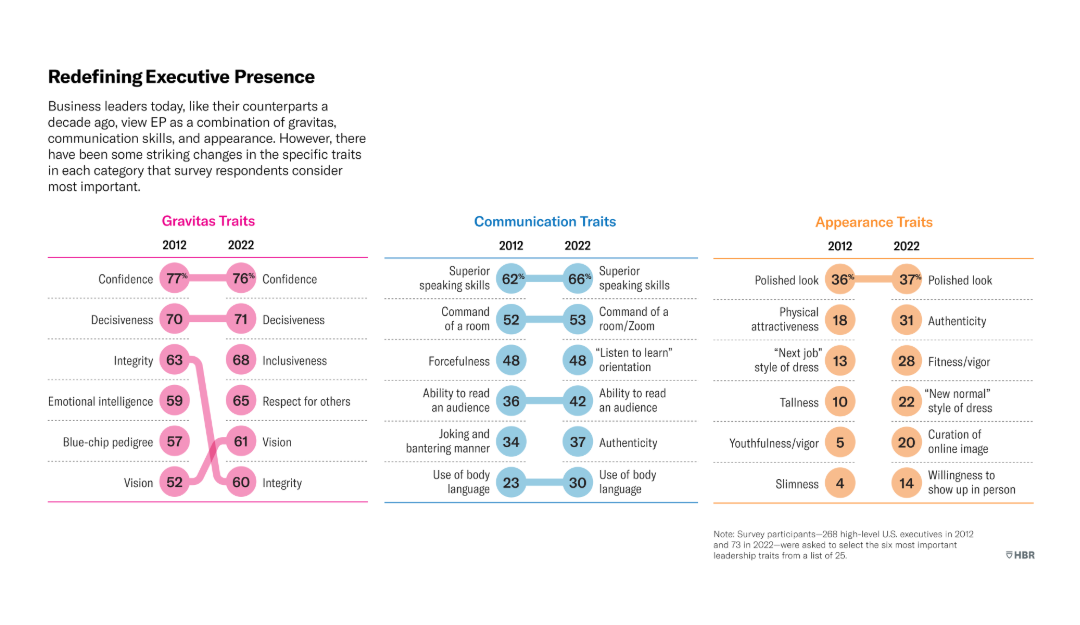
Redefining Executive Presence: HBR chart comparing 2012 and 2022 traits considered markers of gravitas, communication and appearance in senior leaders. Blue-chip pedigree dropped out of the top six. Integrity, inclusiveness, vision and authenticity rose. Curation of online image entered the appearance category at 20% in 2022, having not been a measurable trait at all in 2012.
Source: Sylvia Ann Hewlett, “Redefining Executive Presence”, Harvard Business Review (2022 update of 2012 research).
Read against the Man Bites Dog findings, the alignment is striking. The traits that have risen are precisely the ones a founder is structurally placed to demonstrate and a large firm is structurally placed to suppress. Authenticity. Integrity. Vision. The ability to read an audience. A specific point of view delivered in a recognisable voice. And, sitting at 20% in the 2022 appearance category, an entirely new trait that did not exist as a measurable category in 2012: curation of online image.
That figure is the one to underline. One in five senior leaders now reads how an executive manages their visible online presence as a meaningful signal about how they would handle a mandate. Not vanity. Verification. The C-Suite is checking whether the way you show up online matches the expertise you claim to have offline. AI search engines are running the same check at scale, with 85% of brand mentions in commercial AI search now coming from third-party pages rather than your own website, according to AirOps research published in December 2025.
So, the founder needs four things, in this order:
1. The IP
2. The willingness to attach their name and judgement to a specific point of view
3. The traits the C-Suite now reads as executive credibility, which can be cultivated but not faked
4. And the consistent, structured online visibility that lets all of the above compound across the channels where buyers and algorithms now make their first decisions about who to shortlist
The good news for founder-led professional services
The Big 4 cannot do this. Their structure prevents it. They cannot put a single human at the centre, give them an unfiltered voice, and let them build personal authority across press, peer networks, LinkedIn and the platforms where senior credibility is now calibrated. Well, they could if they chose to, but technically their commercial model doesn’t allow it.
Yours does. The expert is already there, the IP is already there, the voice already exists. The work is to make it consistently, systematically, professionally visible to the audiences that now decide who gets cited, found and hired.
That is what It’s a Shovel was built to do, at a price founder-led professional services firms can actually reach. Start with the free AI Visibility Heatmap to see how the six major AI engines currently see you. Then move into Discovery and Strategy, Foundation and Growth as the work demands.
Trust used to be enough. The buyers themselves have now told us it is not. The good news, if you are founder-led, expert and have done the work, is that you are most of the way there already. You just need some help to stop hiding.
Jessica Whitcutt MCIPR is the founder of It’s a Shovel, a strategic communications consultancy that builds reputation, visibility and pipeline for founder-led professional services firms. She has thirty years of strategic communications experience, including leading reputation across Africa for SABMiller, then a FTSE Top 20 company, and is the creator of the Reputation with Purpose framework, first published in 2018.
Frequently asked questions
What does visible expertise mean for a founder-led professional services firm?
Visible expertise means visibly demonstrating that you know more than your competitors about the specific problem your client is trying to solve. Not a brand persona, a real point of view in the founder's voice, backed by track record and corroborated by independent sources. The Man Bites Dog research was conducted with billion-dollar buyers, but the underlying psychology applies at every scale.
Why are the Big 4 not winning despite massive research budgets?
Because the C-Suite has moved on from generic, committee-produced thought leadership. 91% of senior buyers now discount co-branded or sponsored content as adding nothing to their perception of a firm's expertise. The thing that converts IP into confidence is a named, credible human attached to it, and large firm marketing structures are not designed to deliver that.
What does the founder need beyond strong IP?
Visible authority that reflects the executive presence traits the C-Suite now reads as credible: integrity, vision, authenticity, ability to read an audience, and a deliberately curated online presence. HBR's research shows these traits have risen significantly in the last decade, while traits like blue-chip pedigree have dropped out of the rankings entirely.
Where should a founder-led professional services firm start?
With an honest assessment of how visible the founder currently is across the channels where buyers and algorithms form their first impressions. The free AI Visibility Heatmap is the simplest starting point.